Reference
Symbols
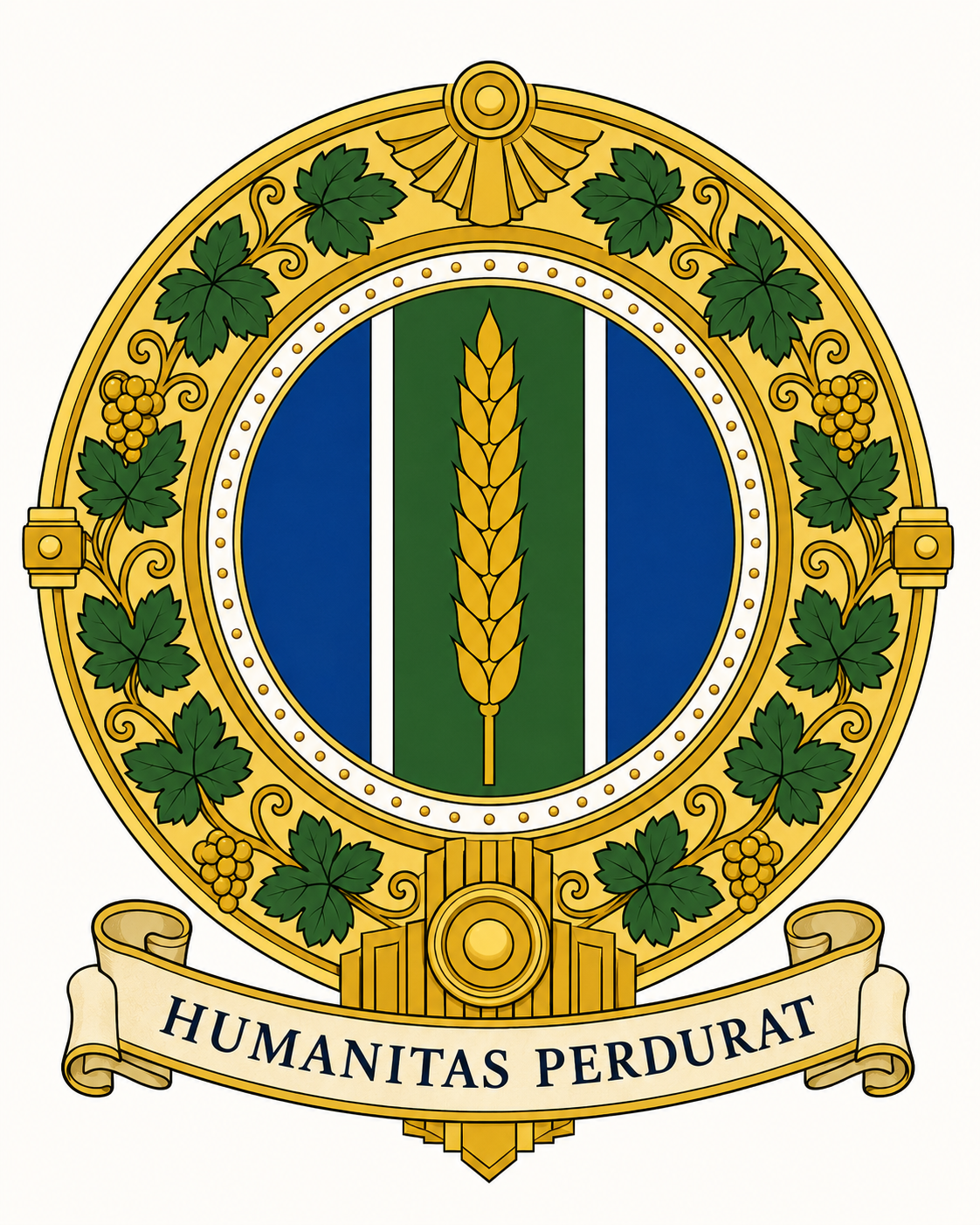
The coat of arms, flag, and logotype of Terra Intermaria — emblems of the inhabited earth between the primal waters, adopted for the editorial presentation of this archive.
Coat of arms
Blazon
A roundel Azure, a pale Vert fimbriated Argent charged with an ear of wheat Or; the roundel environed by an annulet Argent bezanty and a broad outer annulus Or bearing a wreath of grapevine, its stems and fruit Or and its leaves Vert, the annulus clasped at the four cardinal points Or; beneath, upon a scroll Argent edged Or, the motto HUMANITAS PERDURAT in letters Azure.
Symbolism
The circular form presents the emblem as that of humanity collectively and of its planetary commonwealth, rather than of a dynasty or territorial kingdom. The blue fields signify the primal waters from which humanity has been excluded, while the central green pale represents Terra Intermaria, the inhabited and cultivated earth remaining between them; its silver borders mark the inviolable limits of the human estate. The single golden ear of wheat symbolizes subsistence, labour, seed and the continuity of life from generation to generation. The surrounding grapevine represents civilization beyond mere survival — settlement, culture, memory, hospitality and patient cultivation — while the golden frame expresses the unity and durability of the shared human order. The motto HUMANITAS PERDURAT, “Humanity endures,” affirms the continued existence not only of the human species, but also of civilization and humaneness within the limits imposed upon it.
Flag
Blazon
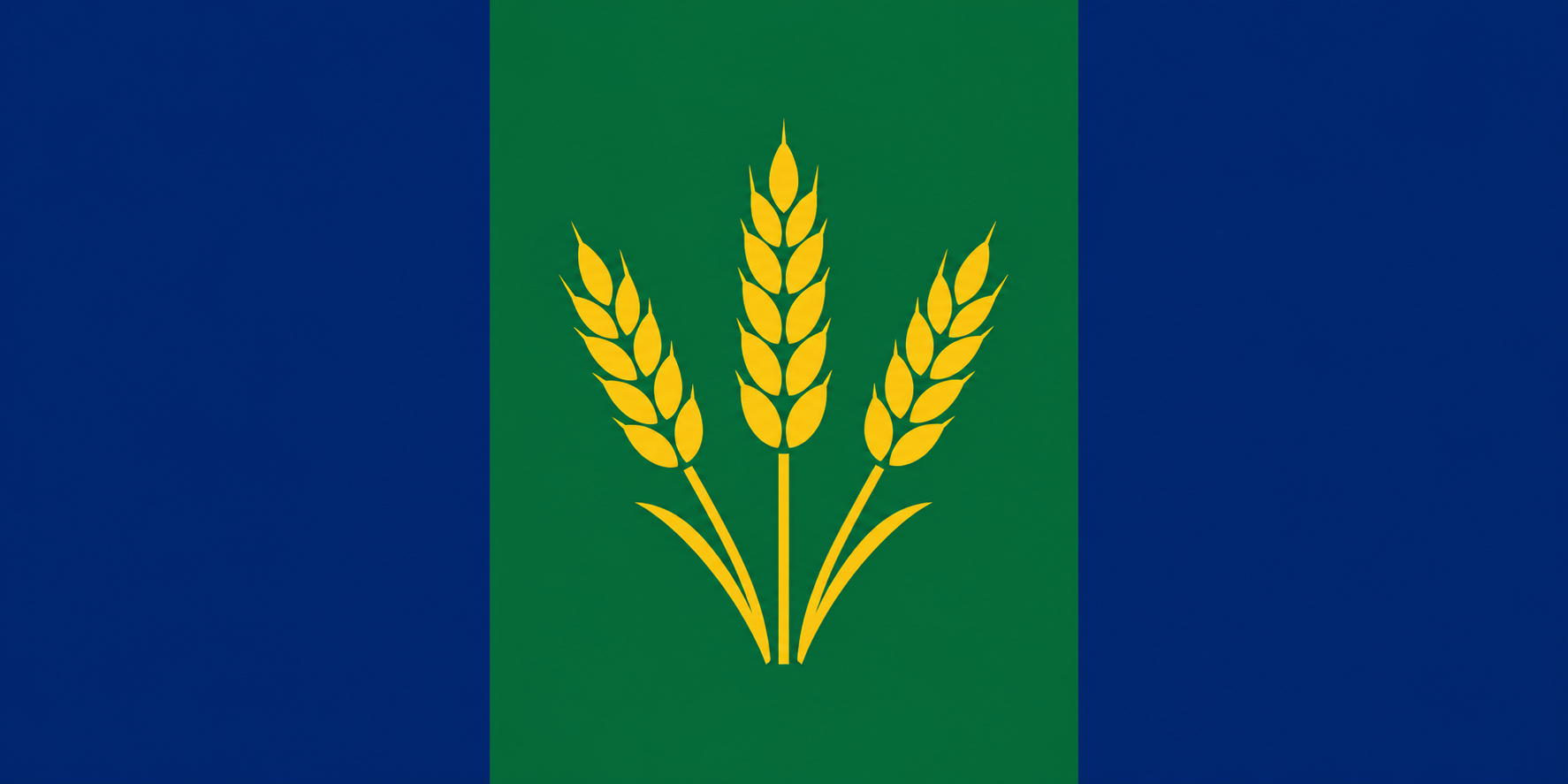
Tierced in pale Azure, Vert, and Azure, the center compartment thrice the breadth of each flank and fimbriated Argent on both sides; on the Vert, three ears of wheat conjoined at the base and displayed fanwise Or.
Symbolism
The flag carries the armorial tinctures and central charge in a form suited to public display. The blue flanks again denote the primal waters; the broad green pale is Terra Intermaria, the cultivated earth that remains between them; and the silver fimbriations mark the inviolable limits of the human estate. Where the coat of arms bears a single ear of wheat, the flag displays three ears conjoined at the base and fanned upward — subsistence, labour, and seed understood not as one harvest alone but as the continuity of generations and the shared field. The omission of the grapevine wreath and golden frame distinguishes the civic banner from the full armorial achievement: the flag is the sign of the commonwealth in motion, not the seal of its ceremony.
Logotype
The site wordmark pairs the name Terra Intermaria in deep green with a blue flourish beneath — the editorial identity of this reading edition, distinct from the in-world armorial and civic emblems above.

Regional signs of non-assent
Protestantism has no universal emblem, authorized badge, or common flag. It is a family of legal, civic, custodial, theological, and political positions rather than one institution, and its signs arise from local losses and practices. Repeating an image across two regions does not make it the movement’s device.
- The empty chair appears in French and other civic commemorations for displaced capitals, ministries, ports, or absent communities. It signifies a place kept open in public memory, not a vacant throne.
- A preserved key or deed belongs to custodial traditions among scattered and displaced peoples. The object may stand for title, inheritance, sacred obligation, or a claim deliberately preserved without a promise of immediate repossession.
- The horizon line marks the threshold as both visible limit and unanswered political sentence. Artists use it differently in coastal memorial work, Japanese continuity practice, and zone-line print culture.
- The tied sea belongs particularly to Lens balladry: water represented as bound, folded, or knotted away from ordinary reach. It should not be detached from that literary setting and presented as a global mark.
- The unlit lighthouse remembers maritime knowledge and a coast whose navigational apparatus can no longer serve its former purpose. British, Dutch, and other littoral uses carry different legal and elegiac meanings.
- The cadastral grid is strongest in Dutch and related title-preservation contexts, where maps and water-board records keep dispossession legible. It signifies continuity of record, not necessarily restoration of every old property claim.
Promethean groups may appropriate fire, ascent, broken rings, or launch imagery, but those signs identify a militant edge and must not be used as shorthand for protestantism as a whole. Likewise, the archive’s coat of arms, flag, and logotype above represent Terra Intermaria or this editorial project; they do not endorse either protestant or meliorist judgment.